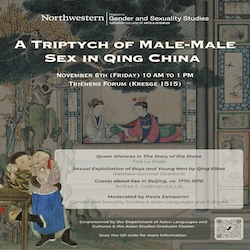
This event consists of three talks followed by Q & A, moderated by Paola Zamperini, Gender and Sexuality Studies and ALC.
Queer Silences in The Story of the Stone
Tina Lu, East Asian Languages and Literatures, Yale
This paper considers The Story of the Stone for its silences, arguing that they are fundamentally shaped not just by sexuality, but especially by same-sex eros. I compare what modern readers see in the novel with what nineteenth-century commentators wrote. Fundamentally, I am interested in reading the novel through its own formal structures. If Jameson famously understood the literary text itself to be “the imaginary resolution of a real contradiction,” our magnificent 80-chapter fragment refutes completion even in the imaginary.
Sexual Exploitation of Boys and Young Men by Qing Elites
Matthew Sommer, History, Stanford University
As many scholars have documented, a distinctive feature of elite male culture in the Ming-Qing era was homoerotic connoisseurship of beautiful boy actors and servants. Such connoisseurship played an important role in elite male bonding and was expressed through shared poetry and an avid fan literature that ranked actors by their beauty and other qualities. What we have lacked is insight into the experiences and perspectives of those who were the objects of such attention, as well as an explicit understanding of the sexual exploitation that underlay all that refined aesthetic expression. This paper explores several sex scandals from the High Qing (documented in legal case records and in confidential reports to the emperor) that involved elite men, including Manchu and Mongol nobles. These scandals, and the subsequent prosecutions of key protagonists, illustrate both the extent of elite male privilege and the limits of official tolerance. They also lay bare the human trafficking and sexual exploitation that were central to Beijing’s famous theatrical world and elite lifestyle.
Gossip about Sex in Beijing, ca. 1770-1870
Andrea S. Goldman, History, UCLA
This paper aims to square the romanticization of male same-sex intimacies as depicted in Qing fiction with the harsh reality of the rape of boy actresses and young serving boys by Manchu grandees and powerful officials as revealed in the Qing legal records. This bifurcated view of Qing male-male sex also maps onto the differing sources and disciplinary methods of the literary scholar and the social historian. Charting a cultural historical approach, this study attempts to bridge this divide by reading multiple genres of mid to late Qing writing—fiction, ballads, fanzine guides to opera in Beijing, etc.—for their gossip about male same-sex love. Gossip punctured the silence surrounding the power hierarchies inherent in male-male sex in fiction such as Story of the Stone (Shitouji 石頭記) and A Precious Mirror of Boy Actresses (Pinhua baojian 品花寶鑑). It also unveils the responses of a broader urban community in both valorizing quasi-egalitarian ideals of love and censuring abuses of power.