The Transiting Exoplanet Survey Satellite (TESS) launched in April 2018 and is undergoing a near all-sky survey to search for planets in the solar neighborhood. The stars TESS observes are 30-100 times brighter than those surveyed by the Kepler mission, enabling follow-up spectroscopic mass measurements and planet atmosphere studies. In its two-year prime survey, TESS will monitor 200k stars at 2 min cadence and will obtain full-frame images of the entire field-of-view at 30 min cadence, providing a gold mine of data to facilitate a vast array of astrophysics and planetary science. I will present an overview of the TESS mission and early science results. I will also present my independent research projects involving TESS data, from planet hunting to characterizing stellar activity for many hundreds of M dwarfs that span a wide range of masses and ages. Finally, I will discuss the implications of the observed population of exoplanets and their host stars for exoplanet formation and habitability.
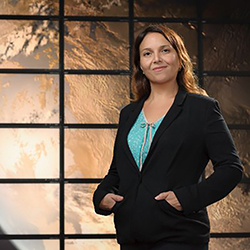
Speaker:Elisa Quintana, NASA
Host: Erin Cox
Keywords: Physics, Astronomy, Astrophysics
Audience
- Faculty/Staff
- Student
- Public
- Post Docs/Docs
- Graduate Students
Contact
Pamela Villalovoz
(847) 491-3644
Email
Interest
- Academic (general)