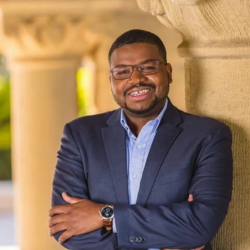
Please join the Race, Ethnicity, and Politics Workshop as they host Hakeem Jefferson, Assistant Professor of Political Science, Stanford University.
This paper develops the concept of collective costs to explain variation in support for intragroup punishment. I argue that when people perceive that the behavior of others in their group imposes costs on the group as a whole, they become more supportive of regulating and sanctioning that behavior. In doing so, the paper shifts attention from abstract notions of shared fate to concrete perceptions of group-level consequences and offers a clearer account of when and why group members endorse social control. Drawing on original survey and experimental data focused on Black Americans, I show that perceptions of collective costs are both widespread and politically consequential. These perceptions are strongly associated with support for punitive responses to norm-violating behavior, and making these costs salient increases support for such responses. Together, the analysis identifies a key mechanism underlying what is often described as respectability politics and sheds light on the broader dynamics of intragroup policing in stigmatized groups.
Hakeem Jefferson is an assistant professor of political science at Stanford University where he is also a faculty affiliate with the Center for Comparative Studies in Race and Ethnicity and the Stanford Center for American Democracy. Jefferson received a PhD in political science from the University of Michigan and a Bachelor of Arts degree in political science and African American Studies from the University of South Carolina.
Jefferson's research focuses primarily on the role identity plays in structuring political attitudes and behaviors in the U.S. Jefferson is especially interested in understanding how stigma shapes the politics of Black Americans, particularly as it relates to group members’ support for racialized punitive social policies. In other research projects, Jefferson examines the psychological and social roots of the racial divide in Americans’ reactions to officer-involved shootings and work to evaluate the meaningfulness of key political concepts, like ideological identification, among Black Americans.