Join the Institute for the Study of Islamic Thought in Africa (ISITA) for a presentation by Yaa Nkrumah (doctoral student in Comparative Literary Studies and English) as part of our Works in Progress series.
Lunch will be served at the talk.
Abstract: Littattafan soyayya, translated to English as “literature of love,” is a popular romance genre written primarily by Hausa women that occupies a paradoxical position within Northern Nigerian literary culture: it is often dismissed as frivolous or morally corrupt, yet it is one of the most widely read forms of women’s writing in contemporary Hausa society. Emerging within a context shaped by colonial educational policy, gendered restrictions on literacy, and shifting Islamic norms, soyayya stands as a critical site for examining women’s engagement with ethical and religious discourse.
This project argues that Nigerian Hausa women writers and Ghanaian Muslim women readers and artists mobilize shared Islamic ethical concepts—such as hakki (rights), haƙuri (patience), and qaddara (divine decree)—that act as a form of figurative Qur'anic interpretation. By tracing the circulation of soyayya into Ghana’s zongo communities and attending to women’s interpretive practices, this study reframes authors, readers, and artists as active participants in Islamic knowledge production.
Thus, this project addresses a critical gap in scholarship on Hausa literature by foregrounding its transnational life and reception. It ultimately contends that soyayya functions not merely as popular fiction but as a mode of narrative reclamation through which women negotiate religious and ethical authority across West African Muslim contexts.
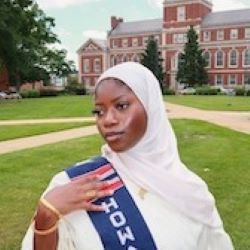
Yaa Nkrumah is a doctoral student in Comparative Literary Studies with a home department in English. She holds two Bachelor of Arts degrees from Howard University in African Studies and Political Science, where she graduated Summa Cum Laude. Yaa’s scholarly investments interrogate embodied performance and the role of women in West African Islamic literary traditions, analyzing how women speak through the narrative as a form of societal critique and simultaneous religious devotion. Broadly, she is interested in the role of women in the Black radical tradition and exploring the literature of the African diaspora.